
Cobb County Public Records Access
Cobb County divides public records by function. The Superior Court Clerk records deeds and keeps superior-court files. Probate Court handles estates, wills, guardianships, and marriage licenses. The Tax Assessor maintains ownership and value data, while Georgia agencies operate vital, professional-license, corporation, correctional, and offender systems. A portal may show an index without providing the signed image or a certified copy.
| Record Type | Record Keeper | Digital Starting Point | Access Route |
|---|---|---|---|
| Deeds, liens, plats, UCC, trade names | Cobb Superior Court Clerk | Clerk search and GSCCCA | Index online; images may require an account or counter |
| Superior and divorce cases | Superior Court Clerk | Clerk records search | Public unless sealed or protected; certified decrees from clerk |
| State Court cases | Cobb State Court Clerk | State Court Records Search | Online courtesy index; official file at clerk |
| Estates and marriage licenses | Cobb Probate Court | Probate Document Inquiry | Available documents online; confidential items withheld |
| Property, GIS, and tax | Assessor, GIS, Tax Commissioner | Owner, address, or parcel tools | Free searches; office fallback |
| Birth, death, marriage, divorce | DPH and relevant Cobb court | Forms and verification services | Eligibility, sealing, and copy rules vary |
| Custody and registries | Sheriff, GDC, GBI | Agency lookup | Current or releasable data; verify with custodian |
Georgia law also protects material within otherwise open files. Social Security numbers, financial accounts, medical and insurance data, a mother’s birth name, and certain birth-date details are redacted. Juvenile and adoption files are generally confidential, and a court may seal other material. The agency should release any part that can lawfully be separated from protected content.
Cobb County Deed Index Modes
The Cobb real-estate index searches much more than deeds. It covers liens, plats, UCC filings, trade names, partnerships, military records, notices, and other recorded instruments. The legacy interface banner reports index data through October 1, 2024. Because that date may be stale, confirm a recent filing through the current Clerk hub or the Deed Room. Georgia’s statewide mandatory online index commonly begins January 1, 1999; older Cobb books or images may require a courthouse terminal or staff help.
| Search Control | Input | Useful Detail |
|---|---|---|
| Name | Reverse name, such as surname then given name | Choose grantor, grantee, or both and test spelling variants |
| Date Range | Preset or specific dates | All years and several recent periods are offered |
| Book Type | Deed, lien, plat, UCC, and other books | Limits results to the relevant recorded series |
| Land Description | District, land lot, subdivision, block, lot, unit | Connects a legal description to recorded instruments |
| Street | Number, name, direction, suffix, unit, city | Finds indexed records tied to a street |
| Book/Page or CFN | Known recording reference | Targets one instrument or filing number |
An index result can identify grantor and grantee roles, instrument type, recording date, book and page or CFN, land keys, and cross-references. Grantor means the person transferring an interest. Grantee means the recipient. The index points toward a document; it is not the same as the recorded image or a clerk-certified copy.
Note: Use Name mode first, then Land or Street mode when a surname changed or an old instrument used a different spelling.
Cobb County Court Record Limits
The Cobb State Court Records Search covers civil cases filed from March 17, 1997, and traffic or misdemeanor matters from April 26, 1999. Searchers can choose civil or criminal, use a phonetic-name option, enter last or company name, first and middle name, dates, and case, citation, or tag data. Birth year appears only in criminal mode. Results are capped at the first 5,000 matches, so a filing-date band can keep a common name manageable.
A docket is the dated list of filings and events in a case. State Court detail may show the case number, parties, charge or civil claim, status, disposition, and docket events. Linked documents vary. The online entry is a convenience record; the clerk’s official file controls when accuracy or certification matters. Superior Court handles felony, general civil, divorce, equity, and title cases. Magistrate uses eFlex for existing-case filing and publishes some calendars, while Probate Court offers estate and license documents through its inquiry portal.
Federal cases arising in Cobb County are filed in the Northern District of Georgia and searched through PACER. Juvenile records are generally confidential under O.C.G.A. § 15-11-700 et seq., and adoption records under § 19-8-23. The Cobb Second Chance Desk explains the local process for eligible criminal-record restriction and sealing.
Cobb County Records Custodian Desks
Sending a request to the right Cobb County custodian saves time. The elected County Clerk is the Board of Commissioners’ keeper, not the recorder of deeds or judicial files. Real-estate and Superior Court records belong with the Superior Court Clerk. Probate has a separate document system. Property ownership questions begin with the Tax Assessor.
Cobb Board of Tax Assessors
736 Whitlock Ave., Suite 200, Marietta, GA
770-528-3100
The Real Estate office is open Monday through Friday from 8:30 a.m. to 5 p.m.; recording and copy counters close at 4:30 p.m. The Deed Room is reached at 770-528-1328, lien staff at 770-528-4022, and indexing staff at 770-528-1332. Those channels matter when an old book, gated image, or newly filed record is not clear online.
Cobb County Property Record Sources
The Assessor and GIS systems answer different questions. The Cobb Board of Tax Assessors search accepts owner name, address, or parcel and is the ownership and valuation source. A parcel is the tract tracked under one property identifier. The Cobb GIS Property Search starts with house number and street only, with no unit, city, state, or ZIP. It returns a PIN, situs address, land district and lot, jurisdiction, service districts, precinct, and school assignments.
Situs means the physical property address. It can differ from the owner’s mailing address, so neither field alone proves where a person lives. GIS links the address and land-lot data to the clerk’s Land search. The Tax Commissioner maintains county bills and collection history, but city tax records are separate. For current parcel-card or assessment questions, contact the Assessor; for legal ownership history, follow the deed record.
Jurisdiction check. A postal city does not establish which Cobb municipality holds a record. GIS shows whether a parcel lies in a city or unincorporated Cobb.
Cobb County Vital Record Eligibility
Georgia does not automatically open birth certificates after 100 years or death certificates after 50 years. O.C.G.A. § 31-10-26 and state vital-record rules control release. Georgia DPH holds birth and death records from January 1919 forward. Certified birth copies go to the registrant or an applicant with a direct and tangible interest. Certified death copies require an eligible family or legal interest, though any member of the public may request a plain-paper death copy with the Social Security number removed.
The state charges $25 for a search and first copy, with additional copies at $5. Online ROVER orders add $8. Mail, online, and in-person channels are available, and mailed birth requests require identification and approved payment. Cobb Probate Court issues and certifies Cobb marriage records at $10 for a license, application, or certificate copy. Cobb Superior Court Clerk keeps divorce decrees. State marriage searches and divorce verifications cover June 1952 through August 1996, but a verification is not the court decree.
Note: Eligibility, proof of relationship, sealing, and certification needs should be checked before paying for a vital-record search.
Cobb County Custody Record Systems
The Cobb Sheriff custody resource reports current detention, charges, and bond information. It does not represent a complete conviction history. Status can change quickly, so the Adult Detention Center is the fallback. Sheriff and Police records also have different custodians; an incident request should name the agency, date, location, people involved, and record type.
State incarceration belongs in the Georgia Department of Corrections offender query, which may show a releasable photo, age or year, description, conviction county, offense, sentence, and release eligibility. Federal custody uses the Bureau of Prisons locator. The GBI Sex Offender Registry searches by name or county and is updated daily, yet the agency warns that it cannot guarantee accuracy. Absence from a jail or registry search can have several causes and should not be treated as proof of a person’s full history.
Cobb County License Record Verification
Georgia’s Secretary of State supplies a public verification system for professions regulated by 42 licensing boards. The Professional License Search is useful when a person claims an active state credential. Search results should be read as licensing records, not as proof of identity beyond the board entry.
The official search page shown below is the state source used for Cobb County license checks.
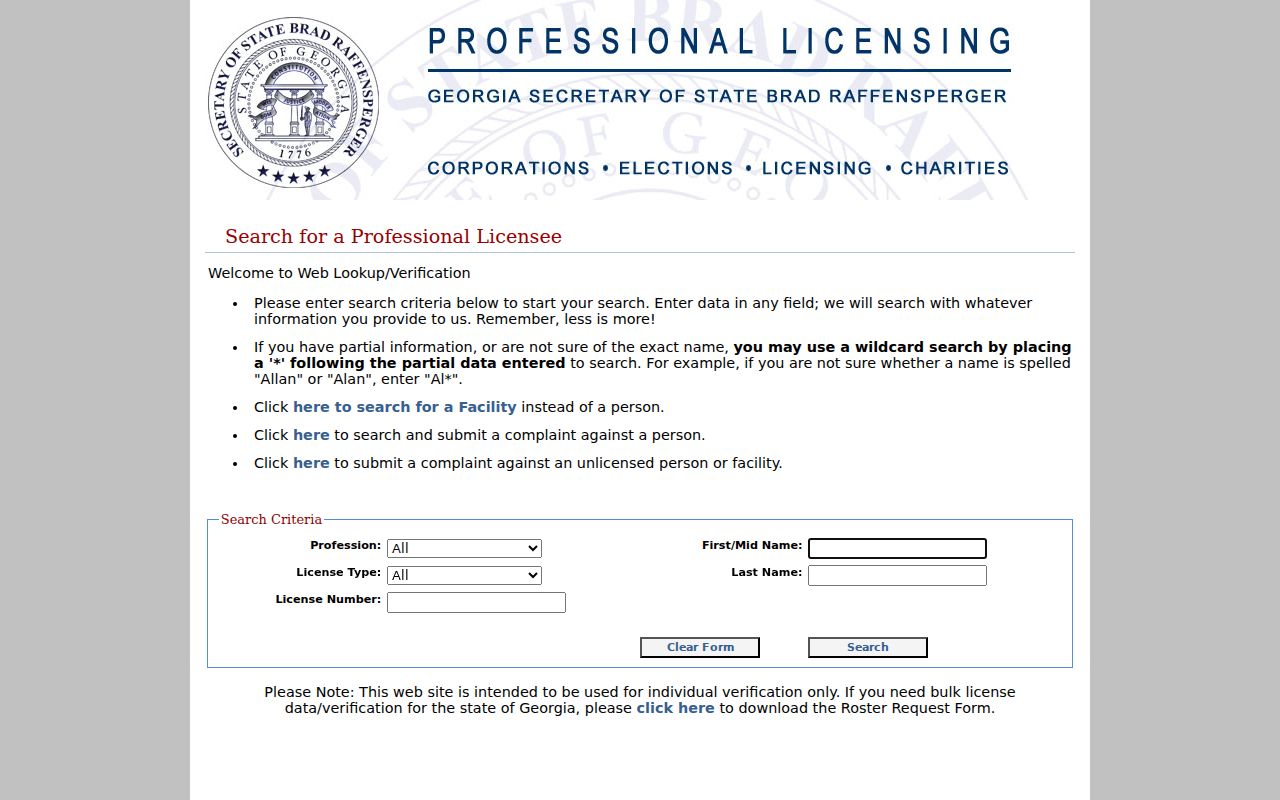
The form routes users to the relevant board’s public record, keeping the verification tied to the agency that issued the credential. Georgia’s Corporations Division separately maintains business-entity filings, while Cobb trade-name records are recorded through the Superior Court Clerk.
Cobb County Recording Alert Safeguards
Cobb’s free Recording Activity Notification can watch a personal or business name, email, phone, street and city, ZIP, parcel, or legal description. It sends an email when matching recording activity appears. The service neither removes a public record nor guarantees title, but it can give an owner time to inspect a suspicious filing with the Clerk.
Georgia added identity-validation safeguards for title filings effective January 1, 2025. The state Attorney General’s title-fraud guidance describes scams built on forged identity and impersonation. A low-cost custodian copy should be compared with any paid solicitation that presents itself as official. Suspected forgery belongs with local law enforcement, while a questionable instrument should also be raised promptly with the Real Estate Division.
Cobb County Record Privacy Boundaries
Open access does not mean every field is visible. GORA requires redaction of protected identifiers while generally requiring release of the remaining record. Georgia’s VoteSafe program protects election address and file data for qualifying applicants. Safe at Home, authorized by O.C.G.A. § 50-18-150 et seq., supplies a substitute address and mail forwarding across participating state and local records. The programs serve different scopes and should not be treated as interchangeable.
- Index
- A list that points to a filed record, sometimes without its image.
- Certified copy
- A copy authenticated by the legal custodian for official use.
- Custodian
- The agency or office that keeps and controls the requested record.
- Exemption
- A statute that permits or requires an agency to withhold protected material.
Commercial data services may collect public and private sources, then display stale or misattributed results. An opt-out may remove a broker listing, but it does not erase the deed, court filing, license, or other source record. Georgia’s consumer guidance recommends using each provider’s privacy process, giving only necessary identity data, retaining confirmation, and checking later for republished data.
Request Cobb County Public Records
The Georgia Open Records Act, O.C.G.A. §§ 50-18-70 through 50-18-77, gives the fallback when no portal supplies the needed record. Requests may be oral or written, but a written request preserves enforcement rights. The agency must provide access within three business days or send a written production estimate, time frame, cost, and exact legal exemption. It need not create a new report or compilation.
- Identify the office that created or keeps the record. Distinguish the County Clerk, court clerks, Sheriff, Police, Assessor, and state agencies.
- Describe existing records with names, dates, parcel, case, document, or incident details. Ask for electronic delivery or inspection when practical.
- Request an advance cost estimate. Georgia requires the most economical means, limits labor to the lowest-paid qualified full-time employee, and makes the first 15 minutes of labor free.
- Pay authorized search, retrieval, copy, or certification costs. Request certification only when the intended use calls for it.
- If access is denied, ask for the exact citation and any segregable portion. Narrow the request or consult the Attorney General’s open-government resources.
The Georgia Attorney General open-government FAQ explains the statute, while the citizen guide gives more detail on requests and enforcement. No Cobb-residency requirement was found. A precise request is still faster than asking an office to research a person or construct a new summary.
Lawful personal use. Public access never permits stalking, threats, harassment, impersonation, or attempts to evade a protected address.