
Choose a Cobb County Directory
Cobb County people directories divide into public staff lists, campus rosters, ownership indexes, regulated-profession searches, and historical collections. Each answers a different question. Smyrna exposes a true A-to-Z employee list. Marietta publishes staff within department pages. Cobb County groups elected officials, courts, leadership, and service contacts. State and university directories extend the search beyond county government. For a private individual, the tax roll or deed index may supply a public name tied to a parcel or transaction, but neither is a household roster.
| Directory | Who It Lists | Keeper | Access |
|---|---|---|---|
| Smyrna Staff Directory | 129 municipal employees | City of Smyrna | Free A-to-Z browse and department filter |
| Cobb Contact Directory | Elected officials, courts, leaders, service contacts | Cobb County | Free online directory |
| Team Georgia Directory | State agencies and named public employees | Georgia DOAS | Free online and printable views |
| KSU directories | University units and athletics staff | Kennesaw State University | Public web pages |
| Cobb tax roll | Named parcel owners | Board of Tax Assessors | Free owner, address, or parcel search |
| Georgia Room | Past residents and businesses in local sources | Cobb County Public Library | Catalog and in-library research |
Begin with the directory that reflects the person’s known role. Use municipal pages for a city worker, KSU sources for campus staff, and the assessor for a named owner. School pages can identify school leaders and contacts, but research did not verify a districtwide surname search. For an earlier resident, the Switzer Library’s Georgia Room and Georgia Archives are the sound fallback. They preserve sources that ordinary web directories miss.
Jurisdiction is part of the search. Acworth, Austell, Kennesaw, Marietta, Powder Springs, Smyrna, and Mableton keep their own municipal contacts, while much of Cobb is unincorporated. Mableton’s service transition also changed which office handles some local work. A person tied to a permit, city program, or council matter may therefore appear in a municipal source rather than a county list. Check the actual government boundary before deciding that a directory has failed.
Search Smyrna's Cobb Directory
The Smyrna Staff Directory is the county’s best-documented municipal people directory. Its counter showed 129 entries, twenty per results page. A visitor can browse all names, select a letter, filter by department, or move through numbered pages. Results show staff name, title, departments, phone, and an email link. Smyrna cautions that not every listed department works at City Hall, so the entry’s work details matter more than the building’s main address.
| Directory Control | Type | How It Works |
|---|---|---|
| A-Z | Browse links | All, number sign, or a letter from A through Z |
| Department | Dropdown | Narrows the staff list by municipal unit |
| Pagination | Page links | First, previous, numbered pages, next, and last |
| Results | Table | Staff, title, departments, phone, and email |
Department tags may be broader than a person’s public title. If the expected unit gives no match, browse the surname instead. The fallback is Smyrna City Hall reception at 770-434-6600 during its published weekday hours, 8 a.m. to 5 p.m.
A typical result reads like a compact business card. The inspected City Clerk entry uses surname-first name, a title, one or more department tags, a direct phone number, and an email link. It does not expose a home address or personal profile. That limited scope is useful: it confirms a public role and supplies an official contact channel without pretending to be a resident database. Search spelling variants when a compound or hyphenated surname returns no result.
Cobb County Government Directories
Government people directories are not uniform across Cobb County. The Cobb Contact Directory emphasizes elected officials, county leadership, courts, and service contacts. Marietta organizes employees within department directories instead of one broad county-style index. Smyrna offers the deeper A-to-Z list. This distinction matters because Cobb includes seven municipalities and large unincorporated areas. A postal city does not establish which city or county unit employs the person.
| Name | Surname-first name in the inspected Smyrna entry |
|---|---|
| Title | The employee's public work role |
| Department | One or more municipal unit tags |
| Work Phone | A direct public contact number when supplied |
| A work email link | |
| Private Data | No home address, biography, or private details in the sample |
A missing name does not prove the person has no public role. Try the department’s page, then its main line or the city clerk. Cobb County administrative records follow a different custodian path; the Cobb County public records overview explains access and request procedures without turning the staff list into an open-records tutorial.
County and city pages also differ in whom they treat as a directory entry. Cobb’s contact list brings together elected officers, courts, and major service units. Marietta’s department pages are narrower, so the reader must first identify the likely unit. That design can work better than a single name search when only the person’s task is known. Call the relevant public office when a page is stale, an email is absent, or the staff role has moved.
County staff titles and elected roles can change faster than a search result is cached. Confirm the office name on its live page before sending a message or using a listed number. For court contacts, choose the specific Superior, State, Magistrate, Probate, Juvenile, or municipal court rather than treating “Cobb courts” as one directory. The County Clerk serves Board of Commissioners records and is not the keeper of deeds or judicial files, another reason to follow the listed department instead of relying on a broad title.
Team Georgia Directory in Cobb
The Team Georgia Directory covers 83 state agencies. Its agency keyword filter, grid and list views, clickable cards, and print mode make it broader than a county employee list. Agency cards show a website, phone, and street address. The printable directory may add an agency head, unit, employee, title, email, and phone. Blank values appear as a dash or “No data available.” Public reading requires no login, though editing does.
The directory includes agencies with a Cobb presence. One local example is the Georgia Department of Defense at 1000 Halsey Avenue in Marietta. The official Team Georgia directory view is shown below.
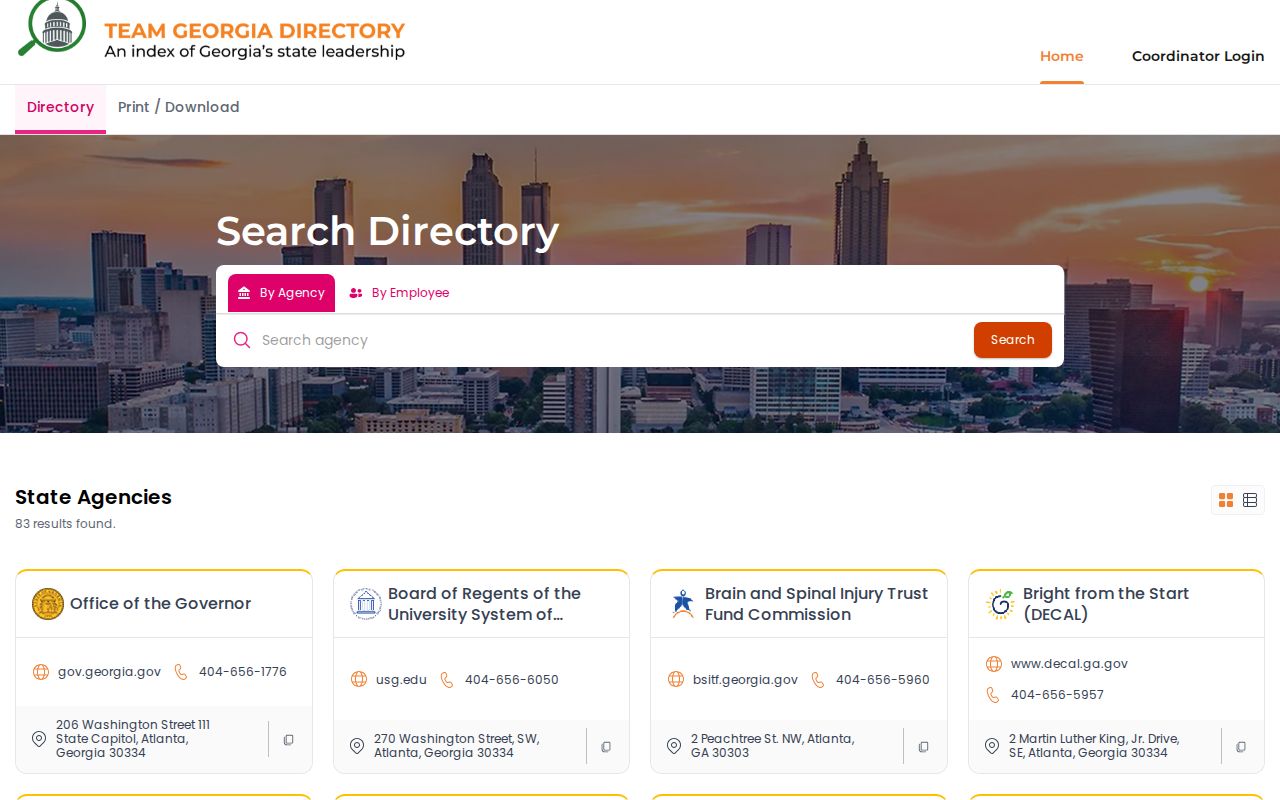
Use an agency keyword when a person’s unit is known, then inspect its card or print view. The captured page confirms the directory’s agency-led structure rather than an unrestricted resident search.
Print mode offers letter-size and booklet layouts. The downloadable edition was last updated September 30, 2025, so compare a printed entry with the live agency card before relying on it. A dash can mean that a field was not supplied, not that the employee or unit does not exist. Team Georgia is strongest for tracing a state function to an agency, then narrowing to the named head, unit, or employee listed there.
An agency-first directory also prevents false matches. Two employees may share a surname, yet their units, titles, work emails, and office phones distinguish them. Record the agency and unit along with the name. If the card supplies only a central phone, ask for the named unit rather than assuming the number is direct. The public fields identify official work contacts, while absent personal details remain outside the directory’s purpose.
Cobb County Campus Directories
Kennesaw State University describes a five-level employee hierarchy: president; division or cabinet; college or business unit; department, research center, or institute; and ancillary center or institute. That structure helps trace a role through the institution even when a simple name form is unavailable. The research did not expose live first-name or last-name controls, so none should be assumed. KSU Athletics separately publishes staff roles, email, and phone.
The Kennesaw State directory source was captured successfully for Cobb County people directories.
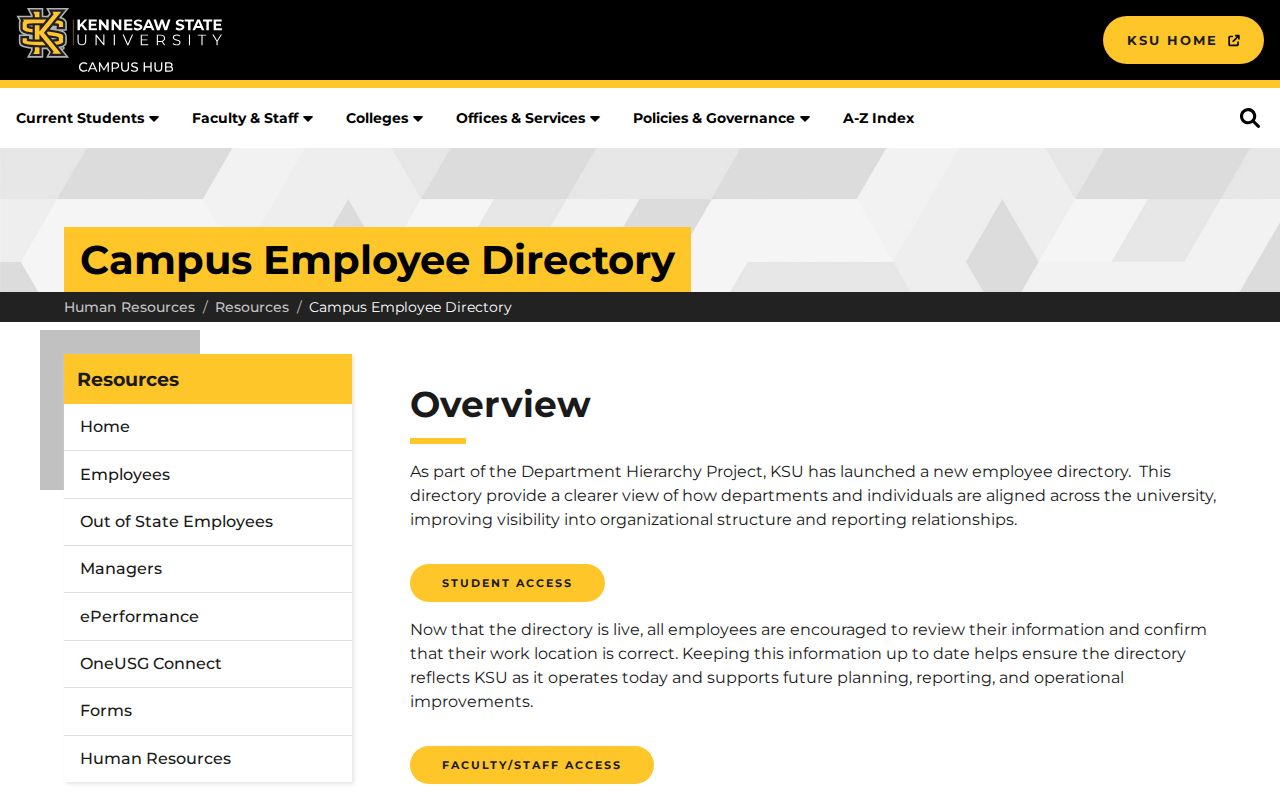
The screen provides an official campus starting point. For Cobb County School District staff, use the public school and leadership pages. CCSD is a very large system, but no official districtwide staff surname form was verified, and permanent former-student files are records rather than a public directory.
Keep alumni material separate from current employee pages. KSU Archives holds institutional records, family papers, organization files, local publications, and audiovisual or born-digital records. Some collections carry legal or donor limits. CCSD’s permanent former-student archive was digitized and microfilmed; a 2012 award account described about 12,000 incoming records each year and roughly 2,000 accumulated cartons. Those figures show the archive’s scale, but the files are not a public people directory.
Cobb County Owner Directories
The Cobb Board of Tax Assessors search works as a current owner directory. It accepts an owner name, property address, or parcel number. A parcel is the county’s keyed unit of land. Its situs address is the physical location, while the owner mailing address is where tax notices go. Those two addresses can differ, and an owner is not necessarily an occupant.
The deed index adds a transaction-based directory. A grantor transfers an interest; a grantee receives one. Search a name in the Georgia clerks’ index gateway, or use Cobb’s clerk search and courthouse terminals for older books and images. Historical volume indexes may require page-by-page browsing because they are not always searchable as one text database.
Start with owner-name search when the present owner is known. If only a street is known, the GIS property gateway can bridge an address to a parcel number and land-lot details. Cobb instructs address searchers to omit the apartment, city, state, and ZIP. Then compare the assessor result with the clerk’s name, land, or street mode. The clerk’s current office and courthouse counters remain the fallback when an older image, book, or name variant does not appear online.
- Parcel
- A mapped and assessed unit of land.
- Situs address
- The property’s physical location, not always the owner’s mailing address.
- Grantor and grantee
- The party giving and the party receiving a recorded interest.
- Reverse directory
- A directory arranged by address rather than only by surname.
Note: Treat ownership and deed directories as named record indexes, not proof that a person currently lives at the listed property.
Cobb Phone Directory Limits
No official current carrier white pages were found for Cobb County. The research also found no unrestricted countywide church, neighborhood, congregation, or member directory. That absence matters. A private roster does not become public merely because it contains names and phone numbers, and it should not be described as a general people directory.
For a current public contact, use the role-based sources instead: a government staff page, school page, university unit, professional license record, or registered business entry. For an older phone or address trail, ask the Georgia Room to check its catalog and physical holdings. Official web pages do not enumerate the years held for telephone, city, or reverse directories. A staff confirmation is more sound than assigning an unverified year to the collection.
Historical names also vary. Search Cobb municipalities separately and try Big Shanty for early Kennesaw material. Compound surnames, diacritics, transliteration, and changed surname order can affect both digital and printed indexes. When an image set lacks full-text search, open the book’s own alphabetical index. That small step often reaches entries a broad web query cannot see.
Telephone and reverse directories answer different questions. A surname-arranged book can connect a name with a listed address or phone in its publication year. A reverse or criss-cross volume begins with the street address and may identify the listed subscriber there. Neither proves every household member, and an omitted number can reflect an unlisted line or a gap in coverage. Ask library staff whether the needed town and year appear in the catalog, then record the book title, edition, and page so another researcher can reproduce the result.
Cobb Professional and Business Directories
The Georgia professional license search accepts profession, license type, license number, first or middle name, and last name. Any field may be used. A partial term can take a wildcard, and using fewer facts may improve a match. Results are primary-source license information. Separate official directories serve physicians, lawyers, real estate professionals, insurance agents, and educators.
Business ties may appear in the Georgia corporation search, which can query business names, registered agents, officers, and designated agents. Cobb trade names sit with the Superior Court Clerk. The published trade-name form and current fee page disagree on the filing charge, so confirm the amount with the clerk before paying. No official public Cobb occupational-tax licensee search was found.
Choose the field that matches the known fact. A license number is the cleanest identifier, while a surname can uncover several professionals with similar names. Corporate records answer a different question: they show a person’s recorded tie to an entity as an agent or officer. They do not prove the person’s present residence or day-to-day control. Trade-name filings may add the named owner or entity and an address, but the clerk’s filed record remains the source to verify.
The corporation interface offers Starts With, Contains, and Exact Match choices. Search may also use a control number, registered agent, officer, or designated agent. A typical entity result can include status, formation or effective date, principal office, agent and county, officers, filing history, and annual registrations. These are business-record fields, not a countywide list of people. Use them to confirm a recorded connection, then read the dated filing behind that connection.
Historical Cobb County Directories
The Switzer Library’s Georgia Room is Cobb County’s main local-history directory stop. It opened in 1970 from Virginia Vanstone Crosby’s bequest and expanded in 2007. The room now offers archives, an African American Collection, genealogy help, Ancestry Library Edition, FamilySearch access, and free Preservation Place digitization. Its parent library system has 15 branches plus a bookmobile. The official web sources do not list exact city, reverse, or telephone-directory years, so confirm holdings with staff instead of assuming a run exists.
The Georgia Room genealogy collection shows the library’s research options.
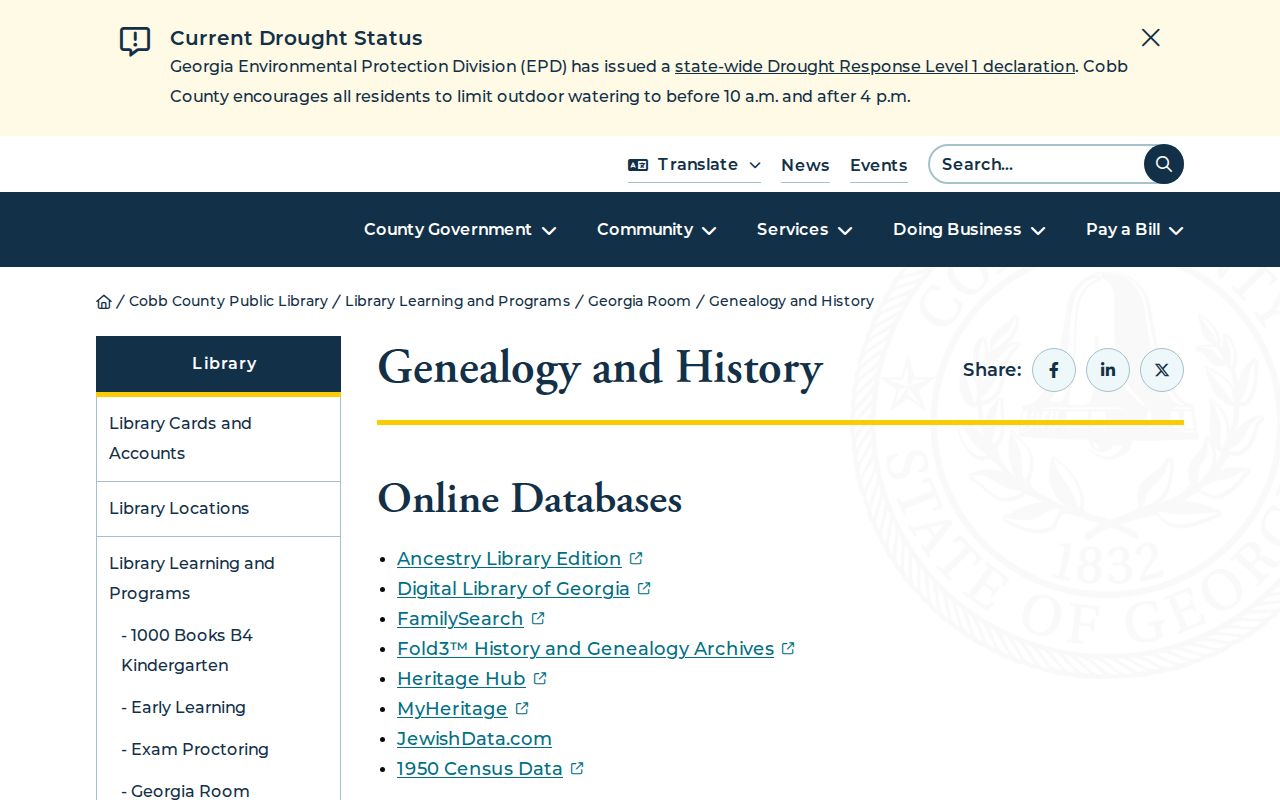
The collection bridges physical sources and digital tools. Search town names such as Marietta, Smyrna, Kennesaw, and the historic name Big Shanty in the Digital Library of Georgia. KSU Archives adds family papers, group records, local publications, and audiovisual material, subject to access limits.
| 1832 | Cobb County was created from Cherokee lands. |
|---|---|
| 1834 | Marietta became the county seat; a surviving Cherokee Territory enumeration includes Cobb but listed white citizens only. |
| 1970 | The Georgia Room began through Virginia Vanstone Crosby’s bequest. |
| 2007 | The Georgia Room expanded its local-history service. |
Georgia Archives county microfilm cards help identify surviving record books, mostly from before 1900. Open a volume’s handwritten or typed internal index when digital images are browse-only. A courthouse-disaster note does not mean every county record vanished. The surviving volume list is the better test.
The 1834 Cherokee Territory enumeration is one example of why a historic list must be read in context. It survives and includes the Cobb area, yet it expressly counted white citizens and cannot represent everyone then present. Pair any directory entry with a census, deed, probate file, newspaper, or family collection from the same period. Agreement among independent sources makes a far stronger identity link than one printed name alone.
For help at the Georgia Room, visit the Switzer Library at 266 Roswell Street in Marietta, call 770-528-2326, or email contactus@cobbcat.org. The room is open without an appointment. Bring the person’s name variants, a likely town, and a narrow date range. Staff can point to catalog records, microform, maps, newspapers, photos, and more than 15,000 genealogy and history resources described in the statewide library profile. Preservation Place can also digitize family photos and media at no cost, creating a useful copy without turning private family material into a public roster.